

How To Open Clean Mobile Home Wall Register

Mobile Home Energy
Step 5: Duct Sealing Techniques
This is the folio opening:
 Duct sealing is like shooting fish in a barrel for the mobile home do-it-yourselfer to handle
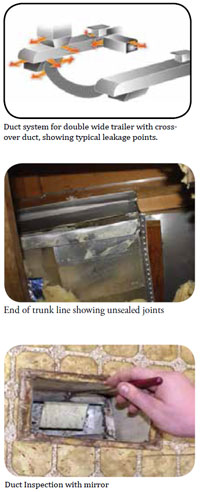
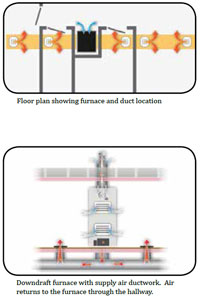 One time you commit to improving the energy performance of your mobile home, fixing up the ductwork becomes one of the first priorities. In almost all cases, the ducts were poorly made at the factory with lots of leaks at the joints. Moving the dwelling to the site location loosens those joints and normal vibration also contributes to leakage. Fortunately, sealing the leaks is relatively easy, quite inexpensive and pays large dividends.
Newer manufactured homes are more efficient than the mobile homes built in the 1960's and 1970's. Furnaces are also better, with sealed combustion now standard. The duct systems however have not evolved. Down draft furnaces, coupled to under-floor trunk lines and risers is still the standard installation method and the workmanship is often junior. The techniques for duct sealing described below are relevant fifty-fifty in newer manufactured homes. Sealing the ductwork may reduce heating bills past 15-17%.
Most mobile homes have a main trunk line (duct) that runs down the middle of the construction, merely nether the floor. Each room has at to the lowest degree i supply register. Most frequently, the air that returns from the room to the furnace only flows out the doorway and down the hall to the grills on the furnace. These systems are chosen "Open up Return" systems.
When the supply ducts leak, that warmed upwards, expensive air is pushed into the belly and lost to the outside surroundings. Y'all lose equally much as 32% of the oestrus produced in the furnace through these leaks. That's expensive and ways that your furnace is working overtime, trying to rut the business firm. Leaky supply ducts besides issue in negative pressure inside the house as the furnace takes indoor air and sends it exterior. Common cold, outside air is pulled into the habitation because of this pressure imbalance.
In a few homes, there are additional registers along the outside walls of each room, and a big, screened hole in the floor adjacent to the furnace. In this type of duct system, the cooler, returning air is pulled back to the furnace through the outside wall floor registers, down the flooring joist cavity and so uses the belly wrap equally the return plenum. This is a "Ducted Common cold Air Return" system. Oftentimes, it is extremely leaky.
If your abode has render air ducts, and they are leaky, your firm will have positive pressure level, forcing warm, moist air from inside the house out through leaks in the walls and roof. Over time, this can rot out the framing, non an uncommon occurrence in older homes. These duct systems normally accept huge leaks and should be converted to an Open Return organisation.
 Converting to an Open Render system is a project you can exercise yourself. First, the return registers, which are unremarkably located forth the outside walls, are removed. The holes in the flooring are plugged with plywood, caulked and the large hole next to the furnace is too permanently sealed.
 Make sure that a sufficiently big pathway to the hallway is available. A furnace technician can check to run into if there is less than a three Pascal pressure level difference between the room and the hallway when the furnace fan is running. If non, then interior doors will need to exist undercut to allow air movement or grills placed in the wall. If the furnace is in a closet with a door, the door must have grills top and bottom to permit the heated air to render to the furnace. In general, the size of these openings corresponds to the opening size of the supply registers.
Sealing the Ductwork
Agreement how the duct system is laid out and how the parts are connected together is a big assistance in identifying hidden leaks. Joints betwixt sections of the duct system are the most mutual location of leaks.
Beginning, if you are having a blower door test on your domicile, have the operator do a pressure level pan test on all ducts while the blower door is operating. High pressure readings indicate big leaks. If they are over 1 Pascal, and then they need to be sealed. Although we recommend that all register boots get sealed, it does make sense to locate the biggest leaks in the duct system. The furnace to chief trunk connexion is oft the worst problem area. In homes with supply registers on the exterior walls, the chief torso to lateral connexion is especially hard to admission. Step ii is to visually audit the interiors of the ducts with a flashlight and mirror. Remove the register comprehend and then lay a flashlight down in the duct facing ane direction. Using a mirror, carefully inspect all surfaces of the ductwork. You will also be able to find and remove any obstructions that have fallen within the ductwork from the register openings. Visual inspection is also useful to check on your sealing coverage.
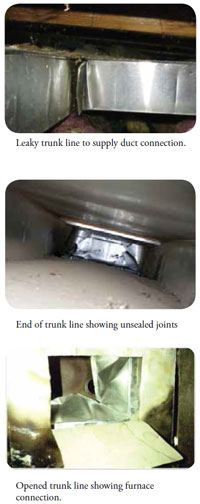 Sometimes the ductwork is exposed under the trailer if the abdomen wrap is damaged. In this case, sealing upward the ductwork might be easier from below, working on the outside of the duct.
The goal is to seal all leaks and open up joints in the ductwork, and to seal the register boot to the wood floor. To seal the duct from above at the flooring register, follow this procedure:
Inspect the interior of the duct and remove all objects that have fallen into the duct. Scrape and vacuum out the duct, and so scrub it down thoroughly with rubbing alcohol and a rag. Use a adept respirator when using the alcohol. Washing downwardly the dirty metal insures that the sealing materials will adhere to the duct.
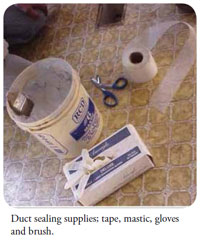
When the metal is make clean and dry out, tape all seams and joints with approved foil faced butyl tape. Do not use "duct tape" which is an junior product and will neglect over time. Record all sides of the kicking upwardly and over the border of the subfloor. Staple that tape to the subfloor. Then, use approved mastic to coat all seams and edges of the tape. Let the mastic dry and replace the annals comprehend. If the register has movable dampers, remove them with a plier or supersede the register with an open cover.
One especially leaky spot is at the cease of the trunk line on both ends of the mobile home. To seal this off, scroll up a 12 inch length of fiberglass batt and place in a kitchen sized garbage bag. Stuff this "poly bag" down the register kicking and into the main trunk line just past the boot. Then utilise your butyl tape to create an airtight barrier. Coat this new duct barrier with mastic.
 If the force per unit area pan indicates that the furnace to torso line joint is leaky, and then sealing is in order. On a few furnaces, this articulation is accessible from above. Often, the merely fashion to admission this joint is to cut a hole in the belly wrap and then cut open the bottom of the main duct direct beneath the furnace. Once exposed, y'all can fold back any loose ends of duct metallic, record the joints and utilize mastic. So close up the lesser of the trunk, screw on a metallic patch, and seal equally higher up. Finally, close up the belly wrap. This procedure is more of a hassle, but essential. If your home has flexible crossovers or joist pan crossovers, a like arroyo may be necessary.
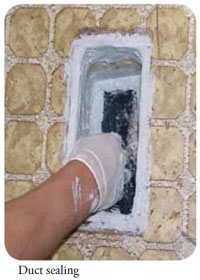 Once all the duct work is sealed up, check for pressure loss with the pressure pan while running the furnace fan. If the readings are within limits, and so you lot can proceed to repair the rest of the abdomen wrap and have your floor insulated. Before y'all are totally finished make sure that bathroom and bedroom doors are undercut then that those rooms don't over pressurize.
Congratulations! You've completed a dirty, just essential first step in improving your home. Now, all that expensive estrus yous are paying for is heating your abode instead of the slap-up outdoors. You'll notice immediate improvement in your comfort and also have lower utility bills.
An fantabulous demonstration that shows how to seal ductwork can exist seen at http://wxtvonline.org/2010/06/ductsealing/

Source: https://www.e3a4u.info/energy-technologies/mobile-home-energy/step-5-duct-sealing-techniques/
Posted by: fikebutial.blogspot.com
0 Response to "How To Open Clean Mobile Home Wall Register"
Post a Comment