

How Manystayes Do You Have To Register For A Political Party
Primal Indicate FROM THIS Commodity
— Birthday, there are 31 states (plus the District of Columbia) with party registration; in the others, such as Virginia, voters annals without reference to party. In 19 states and the District, in that location are more than registered Democrats than Republicans. In 12 states, there are more than registered Republicans than Democrats. In aggregate, 40% of all voters in party registration states are Democrats, 29% are Republicans, and 28% are independents. Nationally, the Democratic advantage in the political party registration states approaches 12 one thousand thousand.
Poring over party registration
This is non the best of times for the Democratic Party. No White House; no Senate; no Business firm of Representatives; and a clear minority of governorships and state legislatures in their possession. Withal the Democrats arroyo this autumn's midterm elections with an advantage in one key aspect of the political procedure — their forcefulness in states where voters register past party.
Altogether, there are 31 states (plus the District of Columbia) with political party registration; in the others, such equally Virginia, voters register without reference to party. Among the party registration states are some of the nation's most populous: California, New York, Florida, North Carolina, Pennsylvania, New Bailiwick of jersey, Arizona, and Massachusetts.
The basic facts: In 19 states and the Commune, in that location are more than registered Democrats than Republicans. In 12 states, in that location are more than registered Republicans than Democrats. In aggregate, xl% of all voters in party registration states are Democrats, 29% are Republicans, and 28% are independents. Nationally, the Democratic advantage in the party registration states approaches 12 million.
All the same, Republican Donald Trump constitute a route to victory in 2016 that went through the party registration states. He scored a near sweep of those where there were more Republicans than Democrats, winning 11 of the 12, while also taking six of the 19 states where there were more Democrats than Republicans — a grouping that included the pivotal battleground states of Florida, N Carolina, and Pennsylvania.
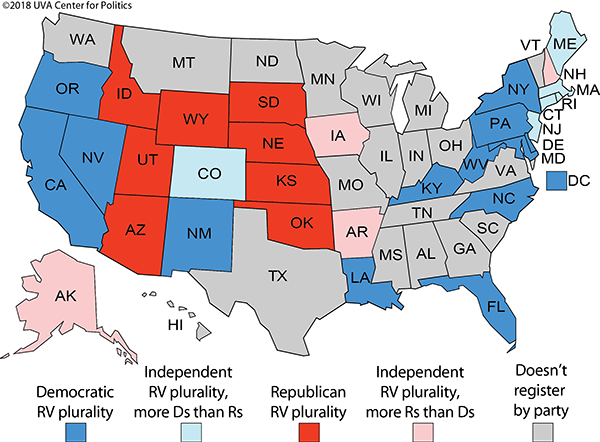
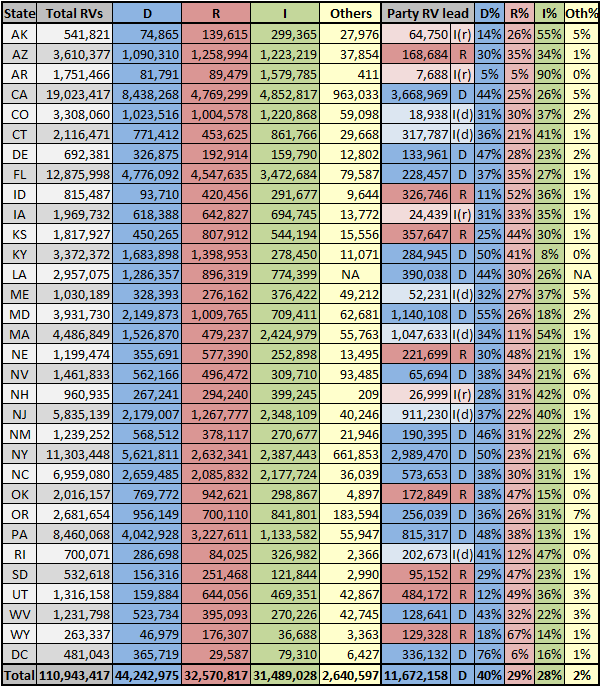
Map one and Table ane: Party registration totals by state, July 2018
Democrats no longer control the White House, the Senate, the Firm of Representatives, or for that matter nigh of the governorships or land legislatures. Simply they still maintain a toehold in the political process with their border in the realm of voter registration. At least that is the instance in the 31 states and the District of Columbia that register voters by party. Equally of this month, 13 of these states (plus the District) avowal a Autonomous plurality in registered voters, compared to eight states where there is a Republican plurality. In the other 10 states, there are more than registered independents than either Democrats or Republicans, with Democrats out-registering the Republicans in half dozen of these states and the GOP with more voters than the Democrats in the other 4. They are indicated in the chart as "I(d)" or "I(r)." Nationally, four out of every 10 registered voters in party registration states are Democrats, with slightly less than three out of every 10 registered every bit Republicans or independents. Overall, the current Democratic reward over Republicans in the political party registration states approaches 12 million.
Sources: Contempo party registration numbers used here are from country election websites and are based on totals compiled in early July 2018. Registration data are every bit of the following months: October 2016 (Kansas and Rhode Isle); February 2017 (Massachusetts); Nov 2017 (Connecticut); January 2018 (Oklahoma); March 2018 (Arizona and Maine); April 2018 (New Hampshire and New York); May 2018 (California, Florida, Maryland, Nebraska, and Pennsylvania); June 2018 (Arkansas, District of Columbia, Kentucky, New Jersey, New Mexico, North Carolina, and West Virginia); and July 2018 (Alaska, Colorado, Delaware, Idaho, Iowa, Louisiana, Nevada, Oregon, Southward Dakota, Utah, and Wyoming).
Notes: In states such as Arizona, Colorado, Connecticut, Iowa, Maine, Nevada, New York, Rhode Isle, South Dakota, and Utah, the total number of active and inactive voters are presented on the state election website, just only the number of active registered voters is used in this article. The "other" column includes voters registered with 3rd parties. Percentages practice non e'er add to 100 due to rounding. Zero percentage (0%) indicates less than 0.5%. "NA" indicates there were no numbers in this category.
Some caveats
At this point, it might be wise to pause and ask the question: Why exercise these numbers matter, either individually or in the aggregate?
Certainly there are facts that argue that they should be taken with a grain or two of salt. Most party registration states are found in more Autonomous terrain: the Northeast (11 states plus the District of Columbia) and the West (10 states), followed by the Southward (half-dozen states) and the Midwest (four states), all of the latter rural states w of the Mississippi River.
To be sure, there are a number of major states that do not register voters past party, such equally Texas, Georgia, Washington, and the keystones of the industrial Midwest: Illinois, Indiana, Michigan, Ohio, and Wisconsin. If they did register past party, Texas, Georgia, and Indiana would virtually certainly add together to the Republican total; the industrial states probably less so.
Comparing political party registration totals between states at a particular bespeak in time can exist a bit misleading, specially because some may have recently completed a purge of "dead woods" on their rolls while others have non. Often, the trend line over a series of years is more than valuable to look at than a 1-time registration count.
States tin also differ on how they study active versus inactive voters. Basically, the latter accept not voted in several sequent elections and have non responded to the efforts of ballot officials to reach them, though they are mostly immune to bear witness upwards and vote if they take non moved. Some states fold in agile with inactive voters to produce i one thousand total. A few states break the ii categories out separately, where the number of active voters routinely dwarf the number of inactive voters, sometimes by a ratio in excess of 10 to 1. (This article uses only land totals of active voters, wherever possible.)
And there is some sentiment that a voter's party identification may mean less than it once did, as the number of individuals who register equally "Contained" (or "No Party Preference," "Unaffiliated," or whatsoever other nom de plumage the individual states adopt) steadily grows. At the get-go of this century, barely 20% of all voters in party registration states were independents. Nowadays, that total is approaching 30%.
Birthday, there are 10 states with more registered independents than either Democrats or Republicans. These states are mainly in the Northeast, with a cluster also in the West. By comparison, in that location are Autonomous pluralities of registered voters in thirteen states plus the District of Columbia and eight other states with Republicans ahead of both Democrats and independents. In addition, there are six states where there is an independent plurality but Democrats outnumber Republicans, and four states where independents are on acme of the registration totals but Republicans outnumber Democrats. That produces the nineteen to 12 land registration reward for the Democrats mentioned earlier.
With the growth in independents, many voters seem to be saying to the two major parties: "a pox on both your houses."
Yet it also can be argued that registering Autonomous or Republican is far more of a statement than information technology one time was. In the current age of precipitous-edged partisanship, there is far more a "dime's worth of departure" between the 2 major parties, and then registering equally a Democrat or Republican is a very intentional act of differentiation.
And that makes the political party registration figures worth looking at. A comparing of political party registration totals on the eve of the 2016 presidential ballot with the actual voting in Nov shows a noticeable correlation between party registration and the state past state election outcomes. Xx-four of the 31 party registration states were won past the nominee whose party had more registered voters (discounting independents for this item comparison). That is a 77% correlation rate between party registration advantage and a winning electoral outcome. The percentage goes upward to 88% if 1 removes the South, the ane area of the land where party registration is a lagging indicator of the fortunes of the two major parties.
Nautical chart i and Table ii: Nationwide political party registration trends since 2000
Since 2000, the nationwide proportion of registered Democratic and Republican voters in party registration states accept both gone downwards, while the percentage of registered independents has steadily grown. The latter has near reached the nationwide percentage of registered Republicans, which has long been second nationally to the Democrats. Altogether, the combined number of registered Democrats and Republicans, which was 77% in October 2000, is at present downward to 69%, while the proportion of registered independents over the same period has increased from 22% to 28%.
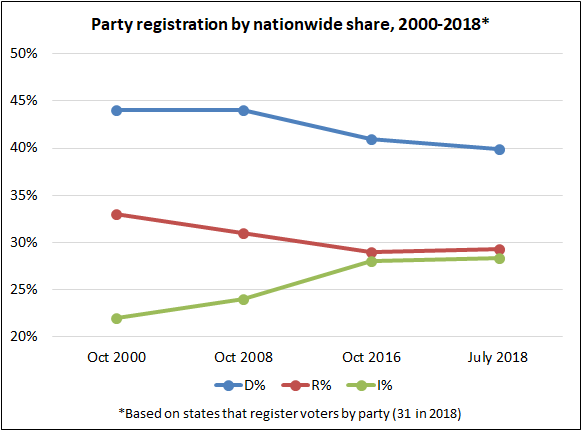

Note: Based on active registered voters in states where the number of active and inactive registrants is listed. In the election-eve 2000, 2008, and 2016 entries, "Independents" include a comparatively small number of registered miscellaneous voters who do not fit into a particular category. Percentages exercise not add to 100 since the small percentage of registered 3rd party voters is not included.
Sources: Richard Winger'southward monthly newsletter, Election Admission News, for election-eve political party registration numbers in 2000, 2008, and 2016; the websites of land election offices for July 2018.
Southern exceptionalism
Even though Democrats began losing their authorization in the S a half century ago, they yet retain a registration reward in four of six Southern states where voters register past party: Florida, Kentucky, Louisiana, and Northward Carolina.
In Arkansas, there is a rudimentary system of party registration in which in that location are a few more Republicans than Democrats, merely a vast majority of voters do not place with either party. In Oklahoma, one of the reddest of states over the last few decades, the party registration advantage did non finally flip from Autonomous to Republican until a few years ago during Barack Obama's presidency. (Oklahoma is the only land this century where the registration advantage has switched between parties and the Republican atomic number 82 is probable to concord for the long term. In battleground states such as Colorado, Iowa, and Nevada, the registration advantage has switched at least once between parties since 2000 and has less of a await of permanence.)
It is an open question as to why other party registration states in the South take not also flipped to the Republicans. For years, they have been regularly voting for GOP candidates upwards and downwards the ballot, including 2016 when the whole region except Virginia went for Trump. White southerners who once registered en masse for the Democrats have been dying off for years. And the time when voters registered Democratic because its primary was tantamount to election is long gone. Withal, in booming states such as Florida and North Carolina, an influx of outsiders registering Democratic could be helping the political party fend off a big GOP registration surge that would flip u.s. to the Republicans.
As it is, Republicans have been steadily whittling away at the Democrats' registration advantage in the Southern party registration states. In Florida, the GOP deficit is now less than 230,000 registered voters after existence well-nigh 660,000 in October 2008. In North Carolina, Republicans trail by less than 575,000 registered voters, afterward existence down by 865,000 a decade ago; while in Kentucky and Louisiana, the GOP registration arrears nowadays is below 300,000 and 400,000 registrants, respectively, less than one-half of what it was in each state on the eve of the 2000 election.
Table three: Country-by-state registration trends since 2000
The nationwide Democratic registration edge has been fashioned on the two coasts, where they take had their greatest electoral success of late. In California lonely, the Democratic registration plurality of less than 1.seven meg voters in October 2000 has more than doubled to near iii.seven one thousand thousand. In New York, the Democratic registration reward swelled from barely 2 million at ballot-eve 2000 to almost iii million nowadays. Beyond much of the Northeast and West, Democrats have as well retained an advantage in a number of party registration states in the South, where they dominated long ago at the ballot box simply have been running on fumes for years. The Democratic registration border in Florida, Kentucky, Louisiana, and North Carolina has been steadily eroding in recent decades yet notwithstanding exists.
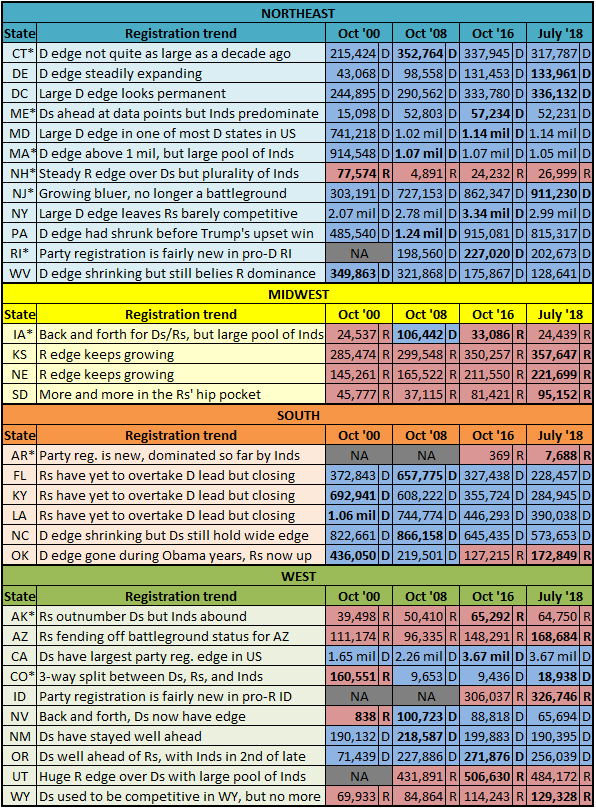
Notes: The largest Autonomous and Republican registration margins amid the iv data points are in assuming. An asterisk (*) indicates that in July 2018, in that location were more voters registered as independent than Autonomous or Republican. "NA" indicates that party registration figures are not readily available. Party registration totals are based on the number of agile voters in states where totals for both active and inactive voters are posted.
Sources: Election-eve party registration figures for 2000, 2008, and 2016 were compiled by Richard Winger and published in his bimonthly newsletter, Ballot Access News. The July 2018 data were compiled by the author from party registration numbers posted on state election websites (see Sources note for Map 1 and Table 1).
Lots of consistency elsewhere
In the rest of the country, in that location was much more consistency between party registration totals and the 2016 ballot issue, with only 3 non-Southern states voting "against the grain." On election eve in Pennsylvania, in that location were 915,081 more than registered Democrats than Republicans; Trump carried the state by 44,292 votes. In West Virginia, there were 175,867 more registered Democrats; Trump won past 300,577 votes. And in New Hampshire, in that location were 24,232 more registered Republicans than Democrats in the fall of 2016, but Hillary Clinton took the state by 2,736 votes. That'due south information technology. The other 22 party registration states outside the South were carried in the presidential balloting by the party with more registered voters than the other.
And in many of these "in sync" states, the registration advantage in recent years has grown more Republican or Autonomous as the example may be, augmented by a healthy increase in independents.
Case in point: California. Eighteen years ago, 45% of the state's fifteen.7 million registered voters were Democrats, 35% were Republicans, and 14% were independents. Terminal month, on the eve of California's June 5 principal, 44% of the 19.0 one thousand thousand registered voters were Democrats (down one percentage bespeak from 2000), 25.5% were independents (up 11 points), and 25% were Republicans (downwardly ten points), equally the Republicans dropped to third place in California registration totals and independents rose to second. In the process, the nation's most populous state has gone from one that was vaguely competitive for the Republicans at the beginning of the 21st century to one where Republicans have trouble competing statewide at all.
The registration trend line in California is a microcosm of sorts of party registration in the nation every bit whole. Democrats are running ahead and the ranks of the independents are growing. Withal registered voters in both parties appear to be widely engaged. That was the case in 2016, and likely will be once more in 2018, with Trump flogging issues to rouse his base of operations. In brusk, this is a highly partisan era when party registration totals, and the trends that go with them, are well worth watching.
Map two and Tabular array 4: Party registration and the 2016 presidential vote
Of the 31 party registration states, 24 were carried in the 2016 presidential election by the party with the nearly registered voters in it. Donald Trump swept 11 of the 12 states with a Republican registration advantage, while Hillary Clinton won 13 of the 19 states (plus the District of Columbia) which had more registered Democrats than Republicans. Four of the Autonomous registration states that Trump took were in the South, led by Florida and North Carolina. He likewise overcame Democratic registration advantages in W Virginia and Pennsylvania to win both. The simply state with more registered Republicans than Democrats that Hillary Clinton carried in 2016 was New Hampshire, where the consequence was very shut.
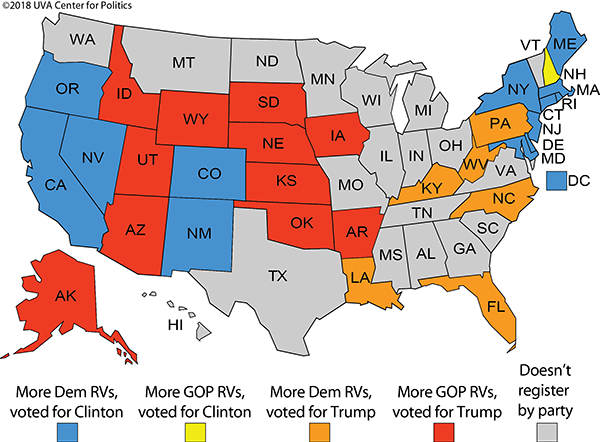
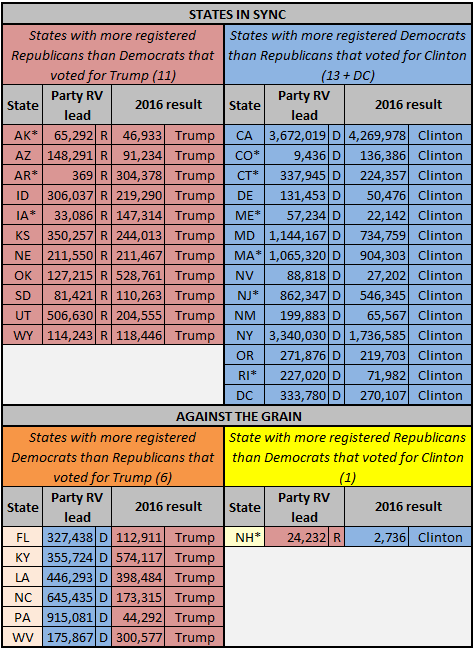
Notes: An asterisk (*) indicates states where there were more registered independents than either Democrats or Republicans in October 2016. "Independents" include a comparatively small number of registered miscellaneous voters who do not fit into whatever detail category.
Sources: Richard Winger'due south Ballot Access News for October 2016 party registration information; America Votes 32 (CQ Printing, an imprint of SAGE) for 2016 presidential ballot results.
Come across Other Commentary by Rhodes Melt.
See Other Political Commentary.
Views expressed in this cavalcade are those of the author, non those of Rasmussen Reports.

How Manystayes Do You Have To Register For A Political Party,
Source: https://www.rasmussenreports.com/public_content/political_commentary/commentary_by_rhodes_cook/registering_by_party_where_the_democrats_and_republicans_are_ahead
Posted by: fikebutial.blogspot.com
0 Response to "How Manystayes Do You Have To Register For A Political Party"
Post a Comment